
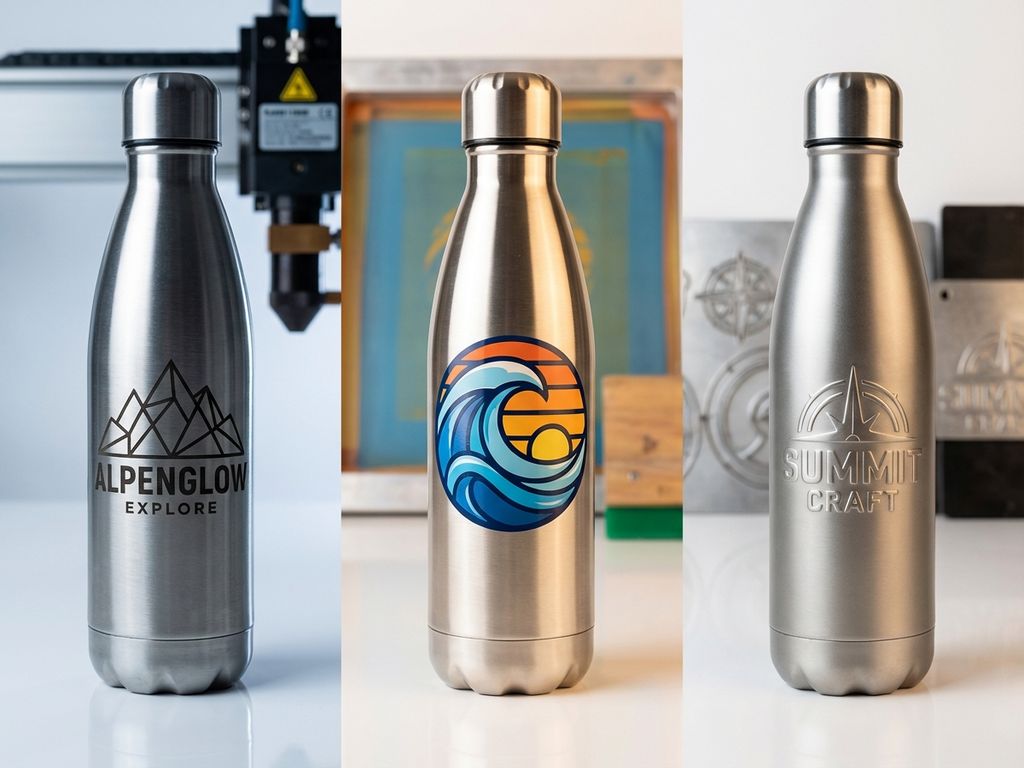
How to choose between engraving, printing or embossing for corporate gifts.
The choice between engraving, printing or embossing depends on your budget, desired look and the material of your gifts. Engraving offers the most durability but is more expensive, printing is cost-effective for large runs and embossing gives an elegant embossing effect. Each has specific advantages and disadvantages in terms of cost, durability and applicability to different materials.
What is the difference between engraving, printing and embossing?
Engraving removes material by laser or mechanical machining, printing applies ink or paint to the surface, and embossing presses an embossed pattern into the material without adding color. These three techniques differ fundamentally in process and end result.
Engraving removes the surface, leaving your logo or text permanently embedded in the material. This works perfectly on metal water bottles and gives a professional, subtle look. The result is always one-color but very durable.
Printing applies the right material to the surface. It allows you to realize multicolored logos and use complex designs. This technique is flexible and suitable for both small and large runs, but the results can wear off over time.
Emossing creates a raised or deepened relief without color. It gives a luxurious, tactile experience and works particularly well on leather or sturdy plastics. Your logo becomes tangible and visible through shading.
Which personalization technique suits your budget best?
Printing is usually the most budget-friendly for large runs, while engraving costs more per piece but has no start-up costs. Embosing is between the two techniques in terms of price and becomes more economical as your print run increases.
For print runs under 50 pieces, engraving is often the best choice. You pay no costs for printing forms or stamps, only for the processing time. For larger runs, printing becomes more interesting because the start-up costs are spread over more pieces.
The complexity of your design affects the cost significantly. A simple one-color logo is always cheaper than a multi-color design with lots of details. With engraving, complexity matters less for the price.
Material costs also come into play. Some materials are more suitable for certain techniques, which can affect your overall cost. For example, stainless steel is excellent for engraving, while Tritan is better suited for printing.
How long will engraving, printing or embossing last?
Engraving lasts the longest because the material is permanently removed - this can last for decades. Printing wears out after 1-3 years with heavy use, while embossing lasts 5-10 years, depending on the material.
Engraved gifts retain their appearance even after thousands of washes. The embossing cannot wear off because it is part of the material itself. This makes engraving perfect for gifts that are used daily.
Printed surfaces are more susceptible to wear and tear. Friction, UV rays and chemicals in dishwashing detergents can affect the print. High-quality UV-resistant inks significantly extend the life.
Embossed designs sit between engraving and printing in terms of durability. The relief is retained, but with very intensive use, the sharpness of the edges may diminish. On quality materials, embossing remains visible for years.
Which technique works best on different materials?
Stainless steel is ideal for engraving and laser engraving, Tritan plastic works best with printing, and leather or solid plastics are perfect for embossing. Each material has specific properties that favor certain techniques.
On stainless steel thermos flasks, engraving gives the best results. The contrast between the shiny surface and the matte engraved parts creates a professional look. Printing on metal is possible but less durable.
Tritan and other plastics absorb printed designs extremely well. You can achieve full-color logos that adhere well to the surface. Engraving on plastic is possible but often gives a less sharp result.
Silicone parts, such as the bottom of thermos cups to-go, are suitable for embossing or embossing. The flexible material holds its shape well and provides a pleasant tactile experience.
Glass and ceramics work well with both engraving and printing, depending on the desired look. Emossing is technically possible on these materials but less common.
Sustainable business gifts: more than just personalization
When choosing personalized business gifts, sustainability plays an increasingly important role. Reusable products such as thermos flasks, travel mugs and eco-friendly alternatives not only impress with their personalization, but also with their positive impact on the environment. A personalized thermos or travel mug is used daily and replaces hundreds of disposable cups every year.
For organizations looking to strengthen their sustainable image, eco-gadgets offer excellent opportunities. These products combine functionality with environmental awareness and can be customized to your corporate identity with all three personalization techniques. White label solutions make it possible to create fully customized gifts that perfectly match your brand identity.
How to choose the right personalization technique for your organization.
Start with your budget and print run, then determine your desired lifespan and see which techniques fit your chosen material. A roadmap will help you make the best choice for your specific situation.
Step 1: Determine your budget per piece and total print run. This will immediately indicate which techniques are financially feasible. Smaller runs make engraving more attractive, larger runs make printing more interesting.
Step 2: See how intensively the gifts will be used. For everyday use, choose engraving; for occasional gifts, printing may suffice. This will help you find the right balance between cost and quality.
Step 3: Consider your brand identity and desired look. Subtle and professional fits with engraving, colorful and eye-catching with printing, luxurious and tactile with embossing.
At Retulp , we are happy to help you make the right choice. Together we will look at your specific needs and advise on the best personalization technique for your gifts. Contact us for personal advice on which technique best suits your organization and budget.
Frequently Asked Questions
Can I combine different personalization techniques on one gift?
Yes, it is possible to combine techniques for a unique effect. For example, you can engrave a logo and print text alongside it, or combine embossing with printing for color accents. This does increase the cost and production time, but gives a very distinctive result.
What happens if my printed gifts get damaged during use?
Printed gifts can wear out over time, especially with heavy use. With quality printing, the logo usually lasts 1-3 years. If you want to ensure longer durability, engraving is a better choice, even though the initial cost is higher.
How far in advance should I order my personalized gifts?
Engraving usually has the shortest lead time (3-5 business days), printing requires 5-10 business days due to print preparation, and embossing can take 7-14 days. Plan at least 2-3 weeks for larger runs and allow for busier periods around holidays.
What file formats do I need for my logo with each technique?
Engraving requires a vector file (AI, EPS or PDF), printing requires high-resolution files (at least 300 DPI), and embossing requires a vector file. Always have black and white versions of your logo for engraving and embossing.
Are there limitations to the size of my logo with different techniques?
Yes, each technique has specific limitations. Engraving works well for logos measuring 10–50 mm; printing can cover larger areas (up to 100 mm); and embossing is usually limited to 30–40 mm for the best quality. Very small details (under 1 mm) can pose problems with all techniques.
Can I have a sample made before ordering a large run?
Definitely recommended, especially for new designs or if you are unsure between techniques. A sample shows exactly how your logo will look and helps you make the right choice. The cost of a sample is often factored into the final order.
What should I do if my logo is too detailed for the chosen technique?
Consult with your supplier about modifications to your design. Often small details can be omitted or the logo can be simplified without losing recognition. Sometimes it is better to choose another technique that can handle more detail, such as printing instead of embossing.
Related Articles
- What are some sustainable Christmas gifts for employees that will actually be used?
- What is the minimum order size for eco cooler bags as a corporate gift in bulk?
- Is an organic sports water bottle suitable as a business gift for clients in the healthcare or education sectors?
- What corporate gifts are perfect for strengthening client relationships?
- Which corporate gifts do clients value most?

